
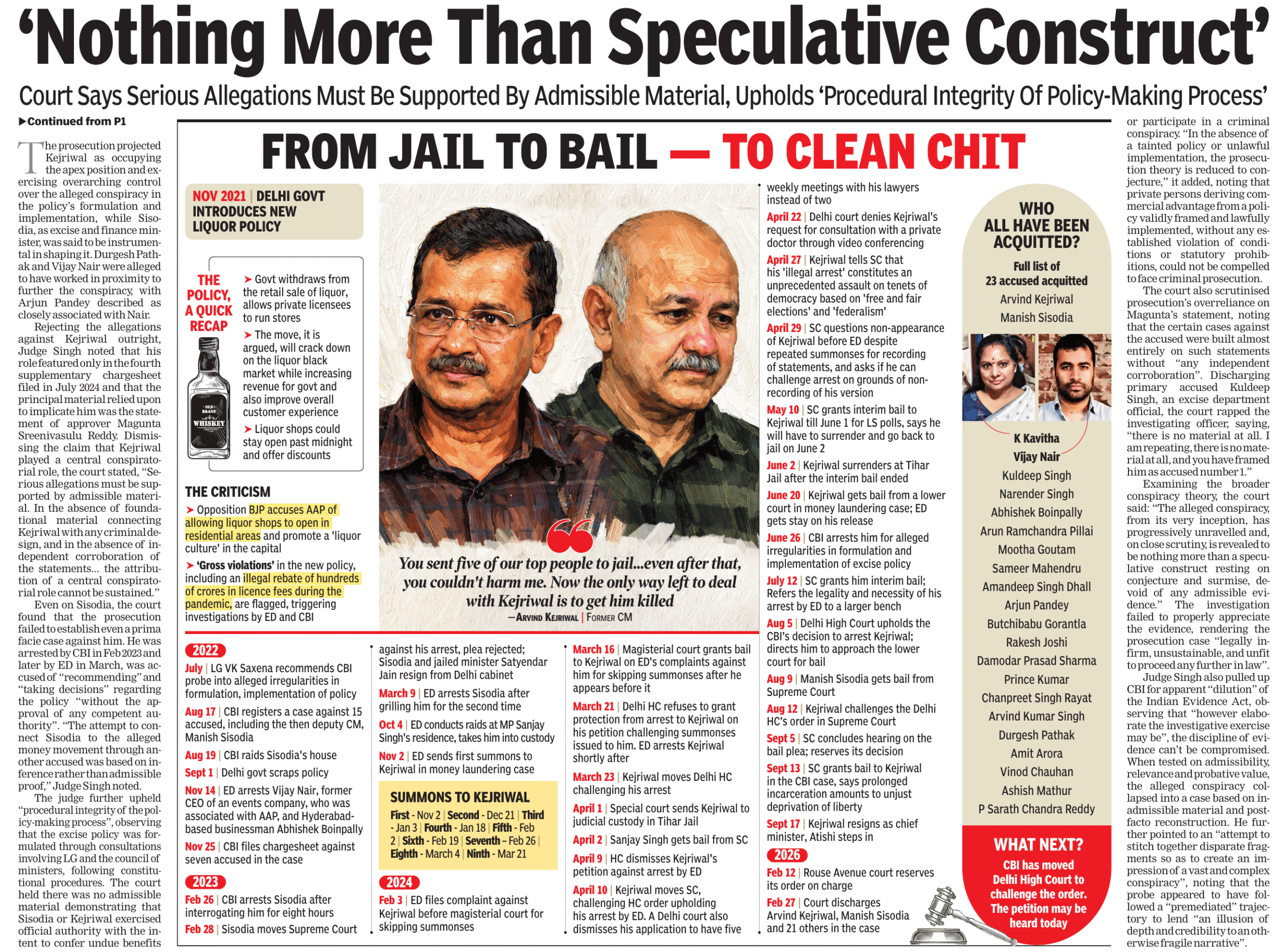
2026-02-27-Judgment-Delhi Excise Policy Case
The trial court’s approach is that even if all facts presented by prosecuting agency, Central Bureau of Investigation (CBI) are assumed to be correct, yet no credible case of corruption under anti-corruption law, the Prevention of Corruption Act, 1988 is made out. It would be futile to subject policy makers to trial. With the trial court’s verdict, money-laundering case will also fall to the ground.
The trial court has also taken note that policy framers are constitutional functionaries who has statutory power to frame policies as considered best by them. The court also found that investigating agencies case primarily rests on corroborative statements of some witnesses. Without this, the case has no legs to stand.
However, at the same time, the trial court’s verdict has tinge of conducting mini trial at the stage of framing the charge. Is it a sound judicial policy to pre-empt trial in this manner? – that is the aspect on which next higher court will have to take a call. The investigating agency may say that trial court has missed vital evidence and has not taken a holistic view of the matter. The CBI in its armoury has sufficient material to argue that trial process has been terminated by deviating from established judicial norms. Those interested to know the material in possession of investigation agency may like to go through the High Court judgment in Manish Sisodia v. CBI, (2023) 2 HCC (Del) 763. There are evidence at least civil servants that policy was tainted by extraneous considerations, and their views were ignored.
Corruption does not have any comprehensive statutory definition in our ant-corruption law. Investigation agencies generally build up their case on causing wrongful loss to Government or conferring undue advantage to a private party. Corruption is a ghost which takes many forms. It haunts but is generally not clearly visible. Same is the case here. There is distinct possibility that higher court may not go along with trial court’s approach. It may allow the trial to proceed though with some riders. At the stage of bail, the matter reached up to Supreme Court which made some observations which may come to the aid of investigating agencies that the trial must proceed. The investigating agency may now be driven to the situation where it has to dig out electronic evidence which is said to have been destroyed.

Delhi Excise Policy case
However, there is a lesson to be leant by both sides. It may be possible to smokescreen political corruption under carpet, but controversy continues to smoulder. The chapter will not be closed with trial court’s verdict. Investigating agencies too must learn that it is not good for them to rest their case on thin ice. We in TheLawyerics have repeatedly noticed that whenever investigating agency does not find sufficient evidence, it falls back on criminal conspiracy which is another elusive ghost difficult to catch hold. This is how the case might take twists and turns, and one day when there is change of power at the centre, the came may be closed as it has happened several times earlier, Bofors, 2G Scam, etc. You and I will remain baffled for all times to time.
Delhi Excise Policy Case