
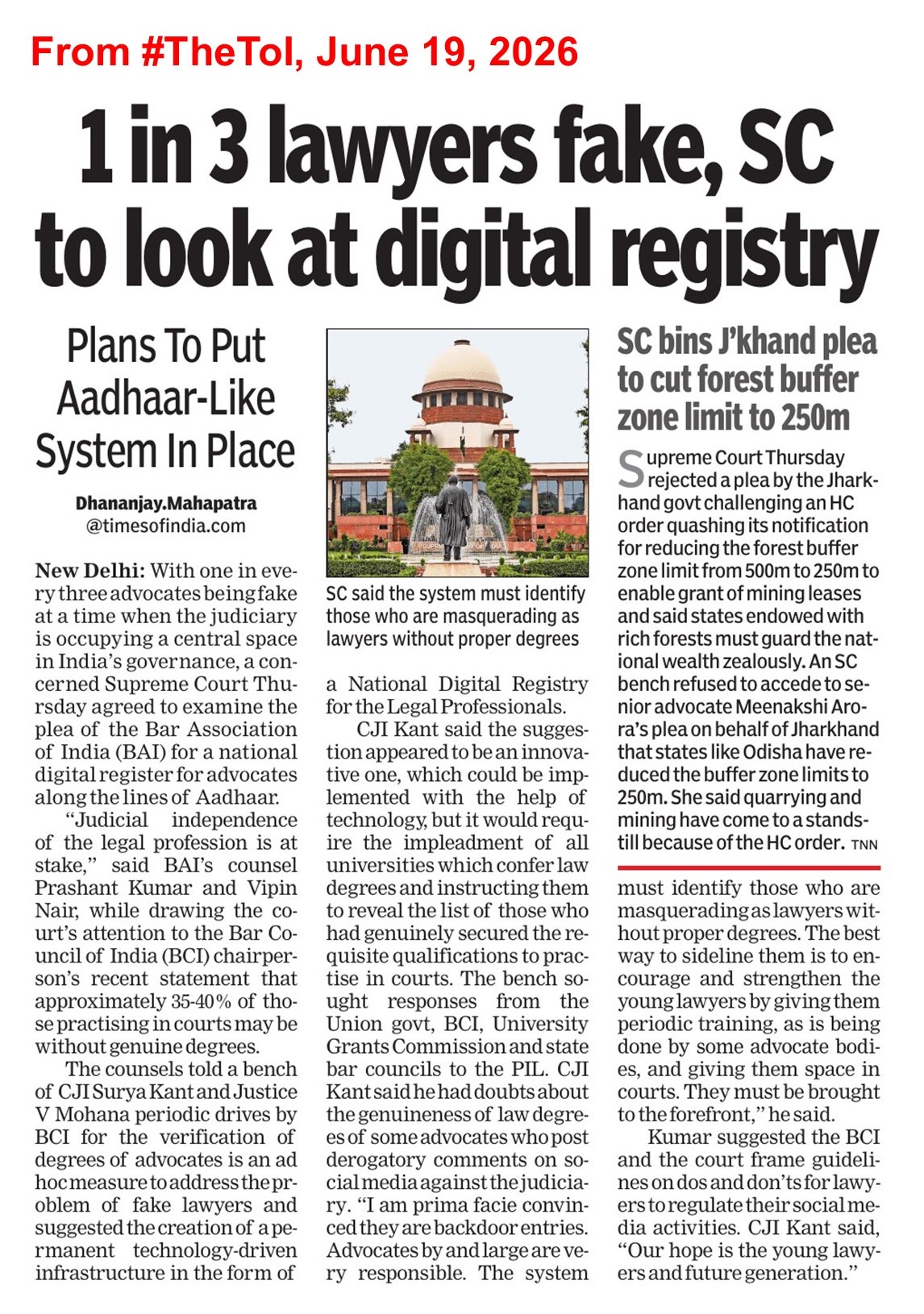
Shocking, if it is true.
However, our experience at TheLawyerics is that fake lawyers might be operating at the district court level but not in High Courts and the Supreme Court. This is happening in district courts because our courts are still using some primitive methods which ought to be dispensed with. A lawyer’s appearance in court should be biometrics-based. In the Delhi High Court, some of the Benches are insisting on appearance through QR code but the foolproof method is that appearance ought to be biometrics-based.
This is not the only area where improvement and efficiency can be brought about in the working of the judicial system with the aid of technology. There are several other areas like court-filings where there is a lot of repetition, unnecessary solemn affirmations, etc, which can be avoided by means of digital identification, and the judicial process can be simplified, but it requires will-power on the part of the legal profession, so that the justice delivery system becomes cost-effective and time-effective. It is our personal experience that at some places, even the courts are not willing to become catalysts of change. They tend to stick to old feudalist methods of judicial dispensation. They still prefer to read paper files rather than digital records. All this is done at the cost of consumers of justice, the litigants.
The Supreme Court has issued a circular on June 3, 2026, seeking suggestions on “Regulations for Use of Artificial Intelligence (AI) in Courts, 2026”, but the slant of the proposal in this circular is to prohibit the use of AI in the area where there ought to be a legal application of mind. However, our view at TheLawyerics is that there ought to be a comprehensive framework where not only the negative effects of AI are avoided in the judicial system, but the benefits of AI are also harnessed to provide a cost-effective and time-effective justice delivery system.
However, our experience at TheLawyerics is that fake lawyers might be operating at the district court level but not in High Courts and the Supreme Court. This is happening in district courts because our courts are still using some primitive methods which ought to be dispensed with. A lawyer’s appearance in court should be biometrics-based. In the Delhi High Court, some of the Benches are insisting on appearance through QR code but the foolproof method is that appearance ought to be biometrics-based.
This is not the only area where improvement and efficiency can be brought about in the working of the judicial system with the aid of technology. There are several other areas like court-filings where there is a lot of repetition, unnecessary solemn affirmations, etc, which can be avoided by means of digital identification, and the judicial process can be simplified, but it requires will-power on the part of the legal profession, so that the justice delivery system becomes cost-effective and time-effective. It is our personal experience that at some places, even the courts are not willing to become catalysts of change. They tend to stick to old feudalist methods of judicial dispensation. They still prefer to read paper files rather than digital records. All this is done at the cost of consumers of justice, the litigants.
The Supreme Court has issued a circular on June 3, 2026, seeking suggestions on “Regulations for Use of Artificial Intelligence (AI) in Courts, 2026”, but the slant of the proposal in this circular is to prohibit the use of AI in the area where there ought to be a legal application of mind. However, our view at TheLawyerics is that there ought to be a comprehensive framework where not only the negative effects of AI are avoided in the judicial system, but the benefits of AI are also harnessed to provide a cost-effective and time-effective justice delivery system.
Click the link below to download PDF
Judicial system
Judicial system