
Compensatory Justice
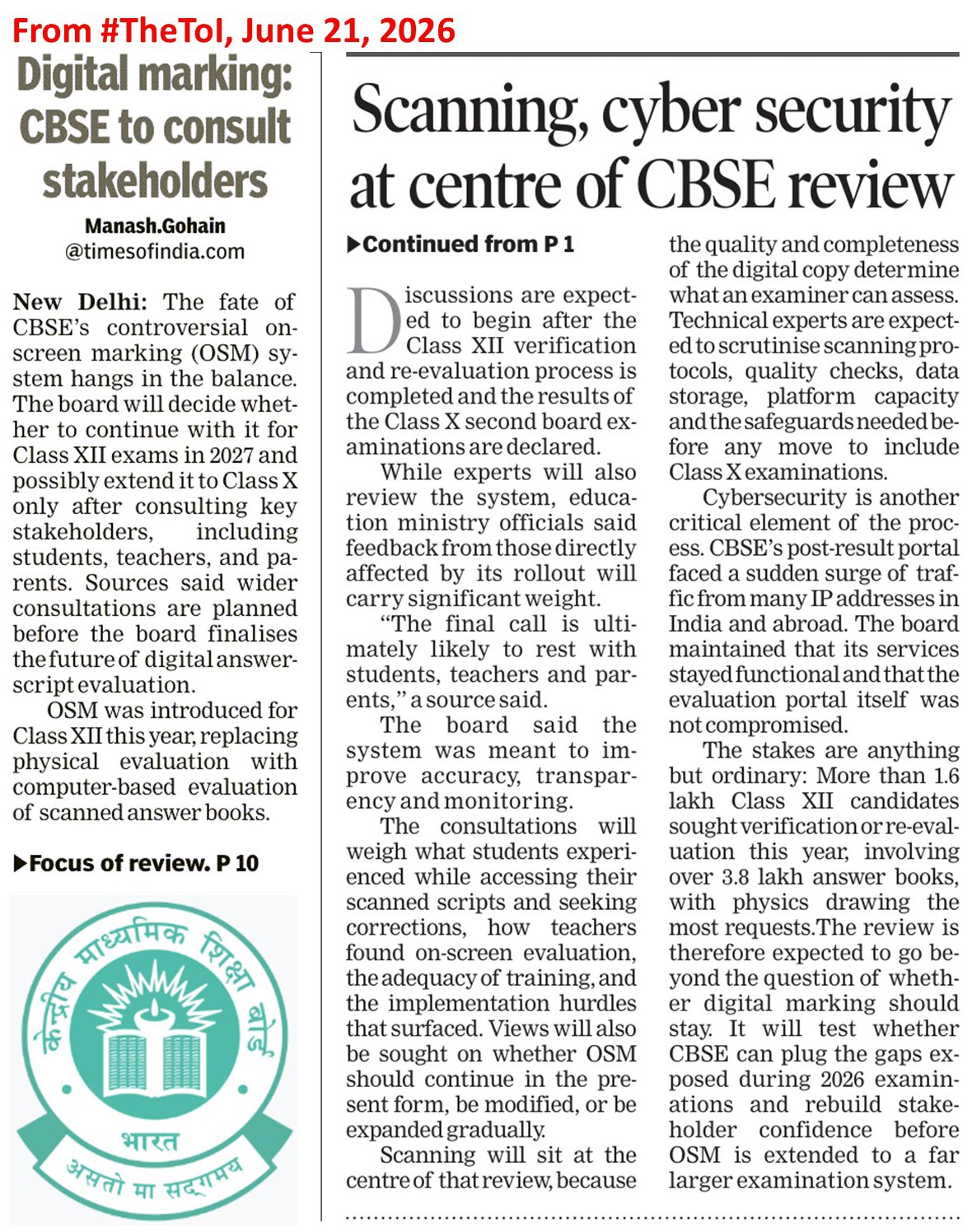
It is about a month we have been seeing the ordeal of young children and their parents who wanted to get their answer sheets reevaluated. They paid for the service and in return they have received anxiety and uncertainty. In the meantime, it also came out that a boy of 17, Sarthak Sidhant could find serious flaws in the tendering process of the CBSE which resulted in the situation now being faced by children and their parents. What is coming into the public domain shows that the tendering process was bungled. Instead of ensuring the best service to the students, the quality was compromised. The sufferers are the children and their parents. These are things which should not remain confined to administrative enquiries and judicial orders. The judicial system ought to move beyond this. There is a need to enforce administrative accountability and create a system of compensatory justice. What fault did the children commit when they paid the examination fee to CBSE to get their academic performance? Did they do it to get intense anxiety in return? Are they not entitled to a foolproof system which should have got their answer sheets re-evaluated answer sheets within a couple of hours so that they could decide what to do next?
The root cause is that accountability is quite weak in Indian administrative machinery and corruption is quite widespread. We at TheLawyerics have lot of experience in dealing with Government offices. The officials feel that they are kings in the chairs they occupy. They do not have fear that they would be held accountable. Agencies like the Central Vigilance Commission (CVC) and the Lokpal have not made the kind of impact they ought to have. It is my personal experience that even the Right to Information, 2005 is being flouted, and no public authority is suffering any harm.
In the USA, the citizens have been armed with certain remedies under the Administrative Procedure Act, Federal Tort Claims Act, etc. but in India, Government officials are protected against criminal proceedings. No court can take cognisance of an offence committed by a public servant in his official capacity, unless sanction for prosecution is obtained from competent authority. This places a man in the street at the receiving end.
The constitutional courts in India have intervened through Public Interest Litigation but they have exercised conventional writ jurisdiction. There is a need to expand this jurisdiction to compensatory justice where a citizen suffers at the hands of the official machinery. There are some stray cases where the constitutional courts have provided monetary compensation for violation of citizens’ rights. The most famous case is Rudul Sah v. State of Bihar, (1983) 4 SCC 141, where the Supreme Court observed as follows, “Article 21 which guarantees the right to life and liberty will be denuded of its significant content if the power of this Court were limited to passing orders of release from illegal detention. One of the telling ways in which the violation of that right can reasonably be prevented and due compliance with the mandate of Article 21 secured, is to mulct its violators in the payment of monetary compensation. Administrative sclerosis leading to flagrant infringements of fundamental rights cannot be corrected by any other method open to the judiciary to adopt. The right to compensation is some palliative for the unlawful acts of instrumentalities which act in the name of public interest and which present for their protection the powers of the State as a shield. If civilisation is not to perish in this country as it has perished in some others too well known to suffer mention, it is necessary to educate ourselves into accepting that, respect for the rights of individuals is the true bastion of democracy. Therefore, the State must repair the damage done by its officers to the petitioner’s rights. It may have recourse against those officers.” This was followed by Nilabati Behera v. State of Orissa, (1993) 2 SCC 746 where monetary compensation was awarded.
At least, the CBSE fiasco calls for a similar treatment for monetary compensation.
The root cause is that accountability is quite weak in Indian administrative machinery and corruption is quite widespread. We at TheLawyerics have lot of experience in dealing with Government offices. The officials feel that they are kings in the chairs they occupy. They do not have fear that they would be held accountable. Agencies like the Central Vigilance Commission (CVC) and the Lokpal have not made the kind of impact they ought to have. It is my personal experience that even the Right to Information, 2005 is being flouted, and no public authority is suffering any harm.
In the USA, the citizens have been armed with certain remedies under the Administrative Procedure Act, Federal Tort Claims Act, etc. but in India, Government officials are protected against criminal proceedings. No court can take cognisance of an offence committed by a public servant in his official capacity, unless sanction for prosecution is obtained from competent authority. This places a man in the street at the receiving end.
The constitutional courts in India have intervened through Public Interest Litigation but they have exercised conventional writ jurisdiction. There is a need to expand this jurisdiction to compensatory justice where a citizen suffers at the hands of the official machinery. There are some stray cases where the constitutional courts have provided monetary compensation for violation of citizens’ rights. The most famous case is Rudul Sah v. State of Bihar, (1983) 4 SCC 141, where the Supreme Court observed as follows, “Article 21 which guarantees the right to life and liberty will be denuded of its significant content if the power of this Court were limited to passing orders of release from illegal detention. One of the telling ways in which the violation of that right can reasonably be prevented and due compliance with the mandate of Article 21 secured, is to mulct its violators in the payment of monetary compensation. Administrative sclerosis leading to flagrant infringements of fundamental rights cannot be corrected by any other method open to the judiciary to adopt. The right to compensation is some palliative for the unlawful acts of instrumentalities which act in the name of public interest and which present for their protection the powers of the State as a shield. If civilisation is not to perish in this country as it has perished in some others too well known to suffer mention, it is necessary to educate ourselves into accepting that, respect for the rights of individuals is the true bastion of democracy. Therefore, the State must repair the damage done by its officers to the petitioner’s rights. It may have recourse against those officers.” This was followed by Nilabati Behera v. State of Orissa, (1993) 2 SCC 746 where monetary compensation was awarded.
At least, the CBSE fiasco calls for a similar treatment for monetary compensation.
Click the link below to download PDF
CompensatoryJustice
CompensatoryJustice