
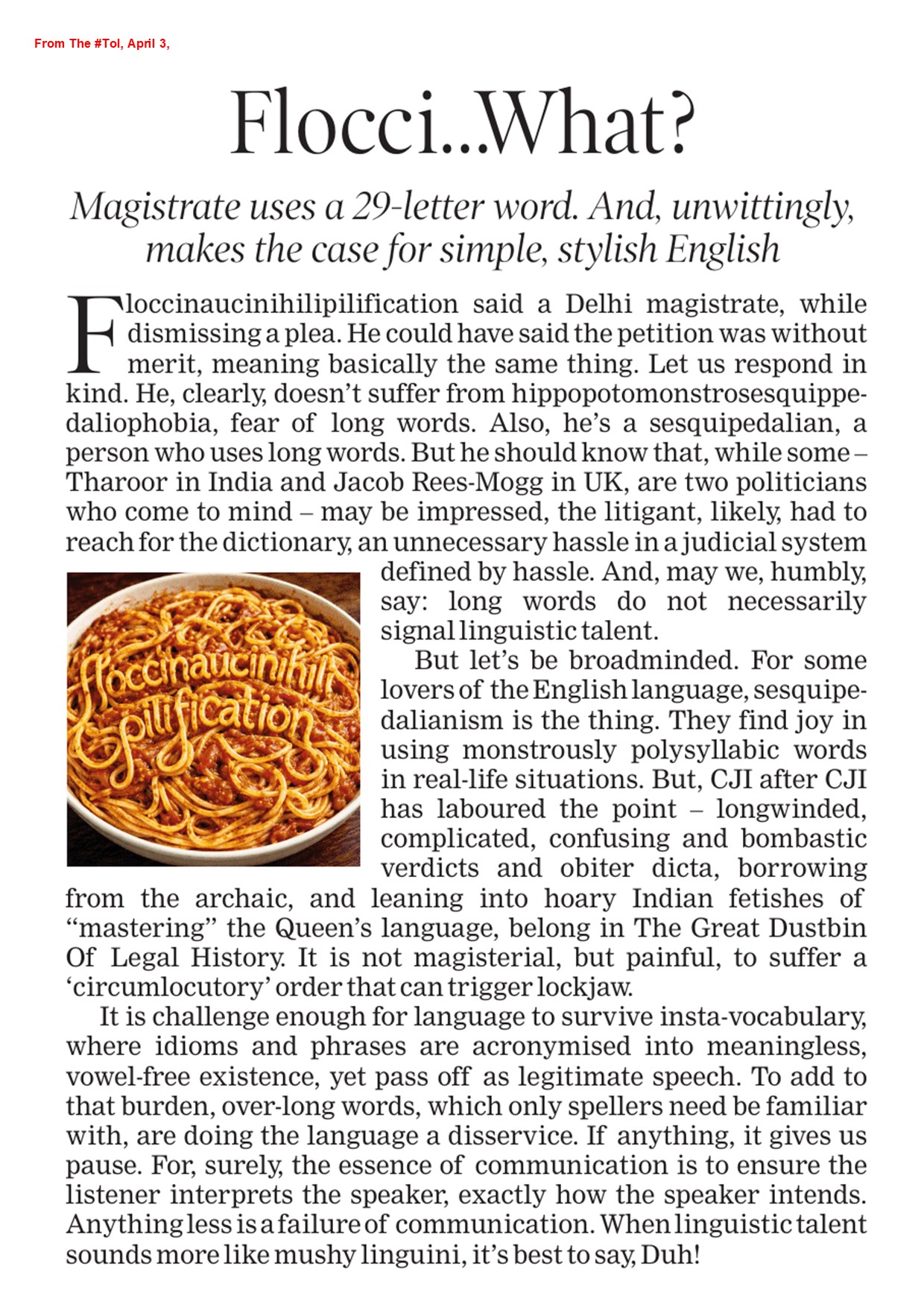
Times of India clipping
The basic principle of law is that a statutory instrument or a judicial verdict ought to be so simple that it can be understood by a common man. There was a time when lawyers felt harassed by high-sounding words of late Justice V.R. Krishna Iyer. The fellow Judge, Justice V.D. Tulzapurkar, took up the issue and expressed the concern of others in the following words, “… prefaces and exordial exercises, perorations and sermons as also theses and philosophies (political and social), whether couched in flowery language or language that needs simplification, have ordinarily no proper place in judicial pronouncements. In any case, day in and day out indulgence in these in almost every judgment, irrespective of whether the subject or the context or the occasion demands
it or not, serves little purpose, …” [Manohar Nathurao Samarth v. Marotrao, (1979) 4 SCC 93]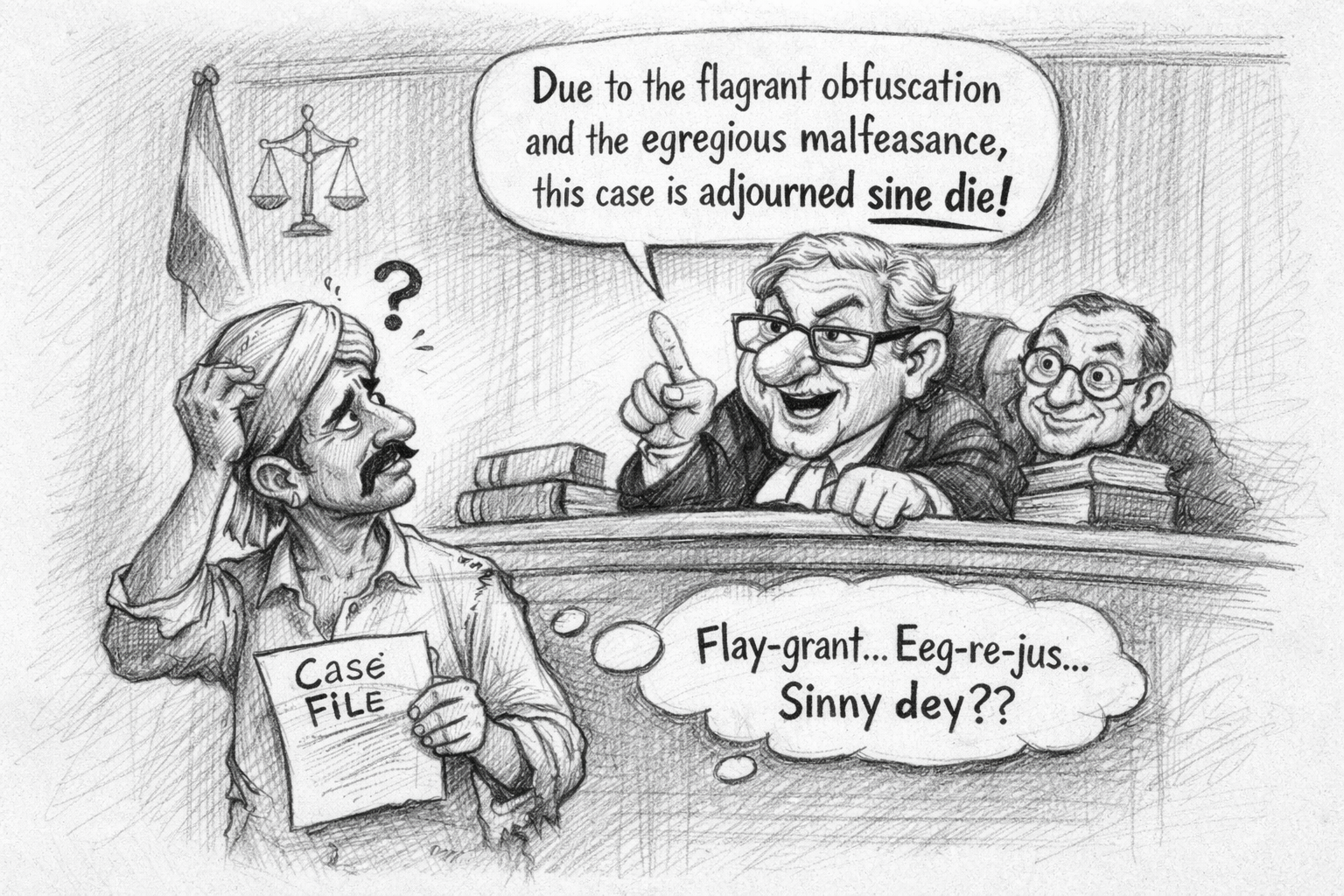 The Judges whose judgments I admire from the point of simplicity of language are Justice Markandey Katju, Justice Yogesh Kumar Sabharwal and Lord Denning. You understand what they are saying whether you agree or do not agree with what they are saying.
While sitting inside Supreme Court and High Courts, I often wonder why at all these learned lawyers are so much fancied by English language. Even in casual conversation in court, they prefer English. Don’t we have any language of our own? If someone speaks in Hindi or in some local language, he or she is considered as rustic lawyer. He may not make good impact on his learned colleagues and so-called elite clients but at least I am not deterred. For me, English is a compulsion while addressing the court because English is the constitutionally recognised language for the Supreme Court and High Courts but I do not like to use it in casual conversation. Subject to this compulsion, why should I ignore my country’s language? Why should I expose slavery of my mind? I prefer simple and clear words of my own language.

The Judges whose judgments I admire from the point of simplicity of language are Justice Markandey Katju, Justice Yogesh Kumar Sabharwal and Lord Denning. You understand what they are saying whether you agree or do not agree with what they are saying.While sitting inside Supreme Court and High Courts, I often wonder why at all these learned lawyers are so much fancied by English language. Even in casual conversation in court, they prefer English. Don’t we have any language of our own? If someone speaks in Hindi or in some local language, he or she is considered as rustic lawyer. He may not make good impact on his learned colleagues and so-called elite clients but at least I am not deterred. For me, English is a compulsion while addressing the court because English is the constitutionally recognised language for the Supreme Court and High Courts but I do not like to use it in casual conversation. Subject to this compulsion, why should I ignore my country’s language? Why should I expose slavery of my mind? I prefer simple and clear words of my own language.
TheLawyerics
Click the link below to download PDF
Judicial Language
Judicial Language